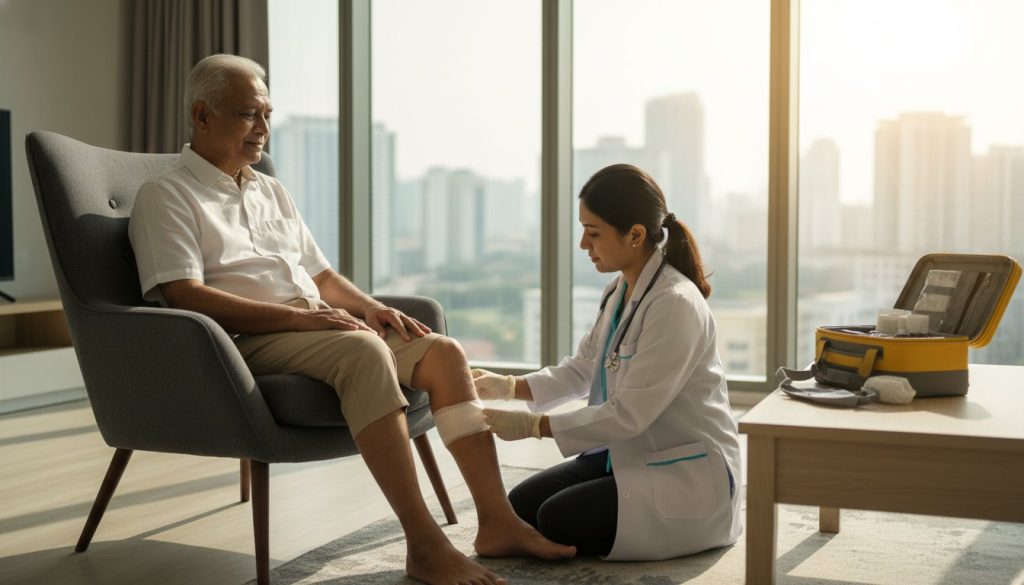

Last Tuesday, Sarah spent four hours in a Kuala Lumpur hospital waiting room just to get her father’s vitals checked. She is one of thousands in the Klang Valley facing the daily struggle of transporting immobile patients for routine care. It’s time to change that narrative. The rapid evolution of healthcare technology malaysia in 2024 is finally bridging the gap between clinical precision and the warmth of your own sofa.
You shouldn’t have to choose between professional medical standards and the peace of your home. We believe that your living room is the ideal setting for primary care. You’ll discover how smart kits and real-time monitoring tools are transforming medical assessments across Selangor and KL. We’ll guide you through the current medtech landscape and show you how to book a seamless, tech-enabled consultation that brings a knowledgeable doctor right to your fingertips.
Key Takeaways
- Understand how Malaysia’s digital health shift is moving professional medical care from sterile hospitals to the warmth and comfort of your own home.
- Discover how the latest healthcare technology in Malaysia empowers house-call doctors with hospital-grade diagnostic tools for immediate bedside results.
- Learn how real-time data syncing allows for faster, more accurate clinical decisions without the long wait times or travel stress of traditional clinics.
- Explore how tech-enabled care provides a seamless solution for specialized needs like palliative support and post-hospitalization recovery in KL and Selangor.
- Gain a simple framework to help you choose the most efficient and integrated care option for your family’s unique health journey.
The Landscape of Healthcare Technology in Malaysia
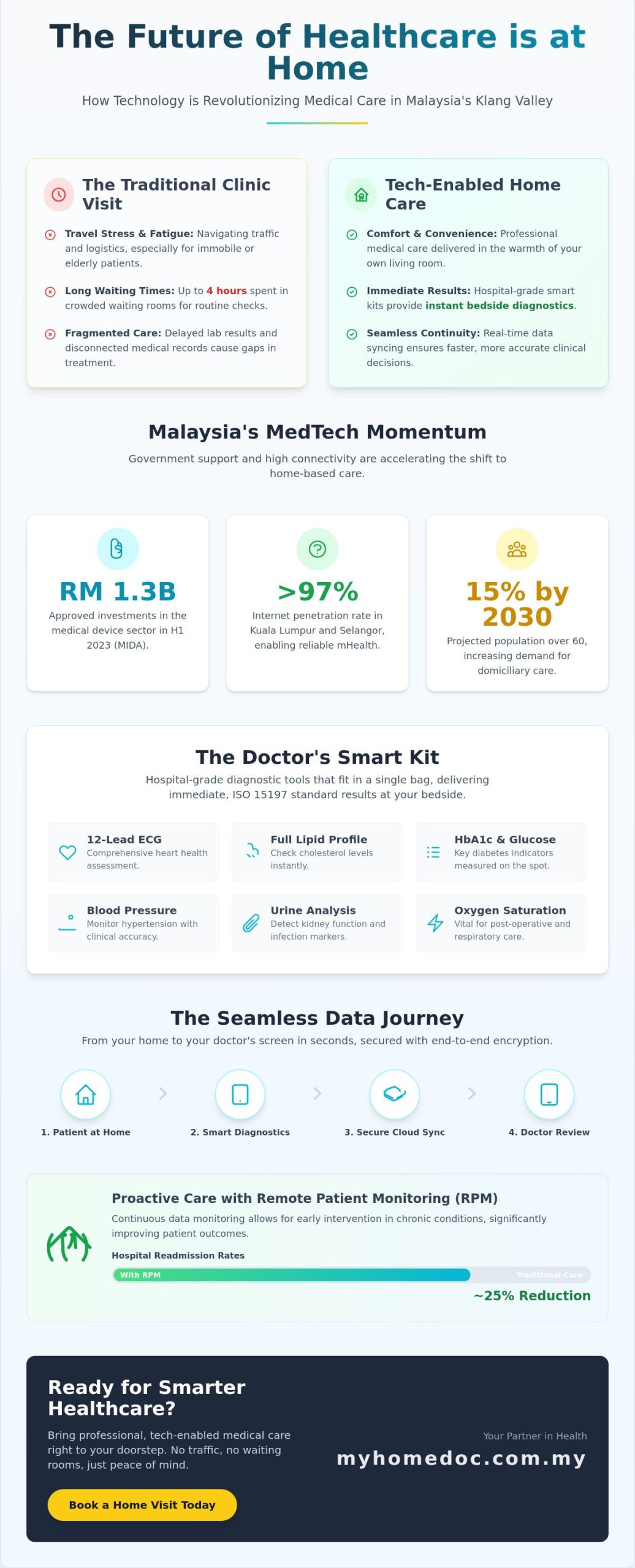
Healthcare technology in Malaysia is undergoing a quiet revolution, moving from sterile hospital corridors directly into your living room. While traditional MedTech often focuses on complex surgical tools, the current focus is on digital health. The Ministry of Health (MOH) and the Malaysian Investment Development Authority (MIDA) are driving this change. In the first half of 2023, MIDA recorded RM 1.3 billion in approved investments for the medical device sector, signaling a strong commitment to innovation. This push is decentralizing the Malaysian healthcare system, allowing you to bypass crowded clinics. The Klang Valley serves as the epicenter for this healthcare technology malaysia adoption, supported by an internet penetration rate of over 97% in KL and Selangor.
From MySejahtera to Mobile Health (mHealth)
The pandemic acted as a catalyst for digital literacy. You’ve already experienced this shift through MySejahtera, which transformed from a check-in tool into a comprehensive health platform for 30 million Malaysians. This familiarity has paved the way for mHealth apps that offer more than just appointment booking. These tools provide a seamless consultation experience, allowing you to track vital signs and share data with professionals in real-time. It’s about removing the stress of travel and long wait times, putting a doctor at your fingertips whenever you need support. Using healthcare technology malaysia makes health management feel like a collaborative journey rather than a chore.
The Growing Demand for Domiciliary Care Tech
As Malaysia moves toward becoming an aged nation by 2030, with 15% of the population expected to be over 60, the need for home-based care is rising. Domiciliary care tech addresses the “last-mile” challenge in healthcare delivery. By using an integrated smart kit, you can perform medical-grade diagnostics without leaving your bedroom. This technology bridges the gap between complex clinical data and your daily routine. It turns your home into a safe, monitored environment, ensuring that elderly family members receive consistent care without the exhaustion of frequent hospital visits. Families seeking quality domiciliary care in Malaysia will find that these innovations make it effortless to bring professional peace of mind to your family’s doorstep.
Smart Diagnostics: Bringing Hospital-Grade Tools to KL Homes
You don’t have to brave the heavy traffic of Jalan Tun Razak for a routine check-up anymore. Modern healthcare technology in Malaysia has shrunk bulky hospital equipment into handheld smart kits that fit right into a doctor’s bag. These devices sync data instantly to the cloud, letting your house-call doctor make clinical decisions at your bedside. You might worry that portable tools lack the precision of a central lab; however, current point-of-care devices meet rigorous ISO 15197 standards, delivering results that match traditional lab settings within a 95% confidence interval.
Remote Patient Monitoring (RPM) uses digital devices to transmit your health data from home to your medical team, allowing for proactive management of chronic conditions like hypertension or diabetes while reducing hospital readmission rates by approximately 25%. For families who have tried a standard online doctor Malaysia video call only to be referred to a clinic anyway, this hybrid approach of real-time monitoring combined with physical diagnostics offers a far more complete solution.
Portable Labs and Point-of-Care Testing (POCT)
Wait times for blood work are disappearing. Using advanced smart kits, clinicians now perform full lipid profiles, HbA1c tests, and 12-lead ECGs on your living room sofa. These tools provide immediate feedback on oxygen saturation and glucose levels, which is vital for elderly patients or those recovering from surgery. This shift is supported by the rise of AI-assisted healthcare in Malaysia, which helps doctors interpret complex data sets instantly to catch potential issues before they become emergencies.
Digital Health Records and Seamless Continuity
Your medical history shouldn’t be a puzzle for your doctor to solve. Integrated digital records ensure that every home-visit clinician sees your full picture, from past allergies to recent prescriptions. In line with the Personal Data Protection Act (PDPA) 2010, Malaysian healthcare apps use end-to-end encryption to keep your sensitive info private. You can enjoy the peace of mind that comes with a personalized health journey where technology serves your comfort. It’s about creating a steady, reliable presence for your family, ensuring that your data moves as fast as your care requires.
The Future of Personalized Care: Why Tech-Enabled Home Visits Matter
The shift toward home-based care isn’t just about comfort; it’s a fundamental change in how we manage recovery and chronic illness. For patients requiring palliative care or post-hospitalization support, the home environment significantly reduces the risk of hospital-acquired infections and improves mental well-being. Modern healthcare technology malaysia allows doctors to monitor vital signs remotely, ensuring that professional medical oversight continues long after a patient leaves the ward. As Malaysia’s digital economy hub expands, these digital health tools are becoming essential for sustainable aging-in-place strategies.
Deciding between a clinic visit and a house call is simpler than you might think. Use this framework to guide your choice:
- Choose a clinic: If you require complex imaging like X-rays or MRIs, or if you’re experiencing a life-threatening emergency that needs a surgical theater.
- Choose a tech-enabled house call: If you’re managing chronic pain, need wound care, or have a high fever that makes travel difficult. It’s also the ideal choice for families who want to avoid crowded waiting rooms during flu season. Learn why a dedicated online doctor Malaysia service with physical diagnostic capabilities outperforms a standard video consultation for these situations.
The integration of medication delivery systems further closes the loop. Once your digital consultation ends, your prescriptions are verified and dispatched. This means you don’t have to worry about driving to a pharmacy while feeling unwell; your treatment arrives at your door, often within hours of your appointment.
MyHomeDoc: Integrating Hardware and Compassion
MyHomeDoc focuses on a “doctor at your fingertips” philosophy. We bridge the gap for families in Puchong, Petaling Jaya, and across the Klang Valley by offering 24/7 medical attention. Our approach combines innovative caretaker tools with real-time monitoring. This ensures that a House Call Doctor Kuala Lumpur provides the same clinical accuracy you’d expect at a hospital, but with the domestic warmth of your own living room.
How to Access Tech-Enabled Care Today
Getting professional care is now a seamless process. You can Book Doctor Appointment Online in just a few clicks. When our tech-equipped medical team arrives at your home in the Klang Valley, they bring a suite of diagnostic tools designed for the domestic setting. You’ll receive a comprehensive examination, immediate digital records, and a clear treatment plan without ever stepping outside your front door. It’s healthcare that respects your time and your environment.
Take Control of Your Health from the Comfort of Your Home
The rapid advancement of healthcare technology malaysia has transformed the traditional medical visit into a personalized, home-based experience. You’ve seen how smart diagnostic tools and real-time monitoring are replacing long hospital queues with immediate, high-quality care. By integrating clinical precision with the warmth of your own environment, modern medicine is becoming more accessible and less stressful for families across the nation. It’s a shift that prioritizes your recovery by removing the friction of travel and wait times.
MyHomeDoc leads this change by offering 24/7 medical attention throughout the Klang Valley. Our qualified GPs and Specialists arrive at your door equipped with portable diagnostic smart kits, providing a seamless bridge between digital innovation and human expertise. This approach ensures you receive hospital-grade insights without leaving your sanctuary. Whether it’s a routine check-up or urgent care, we bring the clinic to you, combining professional rigor with genuine empathy.
Experience the future of healthcare, book a tech-enabled house call with MyHomeDoc today.
Your journey to wellness is a collaborative one, and we’re ready to support you every step of the way in the place you feel safest.
Frequently Asked Questions
What is the current state of healthcare technology in Malaysia for 2026?
The landscape of healthcare technology malaysia is currently defined by the full integration of the Electronic Medical Records system across 150 public hospitals. By 2026, the adoption of 5G-enabled remote monitoring has made real-time consultations the standard for chronic disease management. You’ll find that 70 percent of primary care interactions now begin digitally. This shift reduces hospital congestion and brings precise diagnostics directly into your living room for a more comfortable experience.
Is home-based medical technology as accurate as hospital equipment?
Modern home diagnostic tools are engineered to meet the same ISO 13485 standards required for hospital-grade devices. Today’s smart kits use medical-grade sensors that provide data matching clinical environments. For instance, the Medical Device Authority (MDA) in Malaysia requires these devices to maintain high accuracy rates comparable to traditional lab settings. These tools don’t just track data; they sync with professional software to ensure your doctor receives precise readings for a confident diagnosis.
Can I get a professional blood test done at home in Kuala Lumpur?
You can easily book a professional mobile phlebotomy service that brings a certified nurse to your doorstep anywhere in Kuala Lumpur and the Klang Valley. Services across the city now allow you to schedule blood draws via an app, with results typically delivered within 24 to 48 hours. This eliminates the need to battle traffic on the Federal Highway or wait in crowded lobbies. Once your sample is processed in an accredited lab, the report is sent to your phone.
How does MyHomeDoc use technology to improve patient care?
MyHomeDoc integrates a multi-functional smart kit with a secure telehealth platform to turn your home into a diagnostic hub. We use an all-in-one device that captures high-definition images of the ear, throat, and skin, allowing your doctor to perform a physical exam remotely. By focusing on a home-first philosophy, we make healthcare technology malaysia feel integrated and effortless. It’s about providing a steady, reliable presence that keeps your family’s health on track through real-time monitoring and expert guidance. For those who want to understand the clinical standards behind this approach, our guide to quality domiciliary care in Malaysia outlines exactly what clinical excellence at home looks like.